
People don’t describe accidents, leaks or damaged vehicles in neat database fields. They tell a story, miss details, interrupt and sometimes change languages halfway through.
QulioAI turns these conversations into structured work. It collects the necessary information, checks what’s missing, accepts photos and sends the result to the system where the case continues. Routine calls don’t need a human agent; complex or sensitive cases reach a person with the context already attached.
Qulio holds a live conversation rather than reading questions from a fixed phone tree. Callers can interrupt it, give approximate answers or explain several details at once. The agent remembers what it has already heard and asks only about missing information.
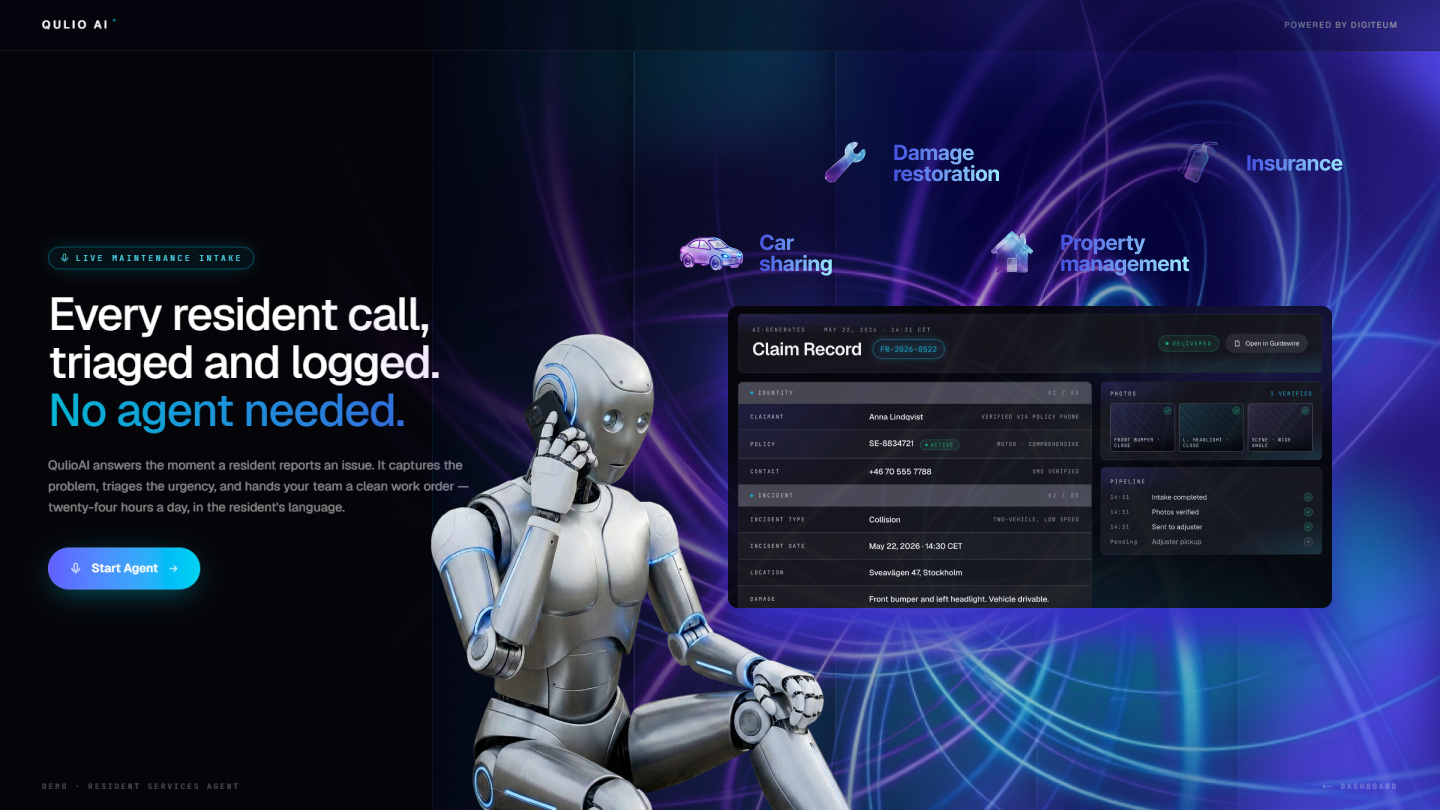
During a motor claim, for example, Qulio can verify the caller, collect the incident story, ask about injuries and vehicle condition, accept damage photos and read the completed summary back. The insurer receives a structured claim record instead of a transcript that someone still has to process.
Companies decide when the agent must hand over. A reported injury may trigger an immediate transfer, while a routine claim can continue without an operator.
Qulio supports more than 30 languages and can follow a caller who changes language during the conversation.
People don’t describe accidents, leaks or damaged vehicles in neat database fields. They tell a story, miss details, interrupt and sometimes change languages halfway through.
QulioAI turns these conversations into structured work. It collects the necessary information, checks what’s missing, accepts photos and sends the result to the system where the case continues. Routine calls don’t need a human agent; complex or sensitive cases reach a person with the context already attached.
Qulio holds a live conversation rather than reading questions from a fixed phone tree. Callers can interrupt it, give approximate answers or explain several details at once. The agent remembers what it has already heard and asks only about missing information.
During a motor claim, for example, Qulio can verify the caller, collect the incident story, ask about injuries and vehicle condition, accept damage photos and read the completed summary back. The insurer receives a structured claim record instead of a transcript that someone still has to process.
Companies decide when the agent must hand over. A reported injury may trigger an immediate transfer, while a routine claim can continue without an operator.
Qulio supports more than 30 languages and can follow a caller who changes language during the conversation.
We first designed Qulio for First Notice of Loss in insurance. The same platform now handles other calls that need information collected, checked and passed into an operational workflow.
Each industry gets its own call flows, terminology, record structure and escalation rules. Other industries are coming.
We first designed Qulio for First Notice of Loss in insurance. The same platform now handles other calls that need information collected, checked and passed into an operational workflow.
Each industry gets its own call flows, terminology, record structure and escalation rules. Other industries are coming.
Voice quality alone isn’t enough. The agent has to stop when someone interrupts, work with incomplete information and know when the conversation has gone beyond what it should handle.
Qulio’s voice runtime uses Python, while the interface and administration layer use React and Next.js, with .NET services in the wider platform. Frontier LLM, STT and TTS models sit behind a provider-independent layer, so the model setup can change according to language, voice quality, response time, cost or regional data requirements.
The platform connects to existing phone systems through SIP and exchanges data with claims, fleet, property and ticketing systems through APIs or webhooks. Where an older system makes direct integration impractical, Qulio can produce a structured email, spreadsheet or case for human processing.
Each customer runs in an isolated tenant with its own endpoint, storage and configuration. We don’t train shared models on customer conversations.
Voice quality alone isn’t enough. The agent has to stop when someone interrupts, work with incomplete information and know when the conversation has gone beyond what it should handle.
Qulio’s voice runtime uses Python, while the interface and administration layer use React and Next.js, with .NET services in the wider platform. Frontier LLM, STT and TTS models sit behind a provider-independent layer, so the model setup can change according to language, voice quality, response time, cost or regional data requirements.
The platform connects to existing phone systems through SIP and exchanges data with claims, fleet, property and ticketing systems through APIs or webhooks. Where an older system makes direct integration impractical, Qulio can produce a structured email, spreadsheet or case for human processing.
Each customer runs in an isolated tenant with its own endpoint, storage and configuration. We don’t train shared models on customer conversations.
RideNow operates a car sharing fleet of around 1,000 vehicles in Cyprus. Its support team receives calls from customers, residents, parking owners and members of the public interacting with RideNow vehicles.
The Qulio platform connects to RideNow’s ERP, CRM, fleet management and ride systems. It retrieves live operational data, follows RideNow’s workflows and creates incident records without an operator taking notes.
During the initial controlled rollout, Qulio handled approximately 30% of inbound support volume within the selected call scenarios. RideNow gained 24/7 multilingual coverage and absorbed seasonal call peaks without expanding its support team.
RideNow operates a car sharing fleet of around 1,000 vehicles in Cyprus. Its support team receives calls from customers, residents, parking owners and members of the public interacting with RideNow vehicles.
The Qulio platform connects to RideNow’s ERP, CRM, fleet management and ride systems. It retrieves live operational data, follows RideNow’s workflows and creates incident records without an operator taking notes.
During the initial controlled rollout, Qulio handled approximately 30% of inbound support volume within the selected call scenarios. RideNow gained 24/7 multilingual coverage and absorbed seasonal call peaks without expanding its support team.


