
Digiteum deployed its multilingual AI voice agent platform for RideNow to handle first line operational
communication across a 1,000 vehicle car sharing fleet in Cyprus. The platform established 24/7 voice
coverage, handled peak seasonal call volume, and allowed RideNow to scale operations without expanding the
support team.
Digiteum deployed its multilingual AI voice agent platform for RideNow to handle first line operational
communication across a 1,000 vehicle car sharing fleet in Cyprus. The platform established 24/7 voice
coverage, handled peak seasonal call volume, and allowed RideNow to scale operations without expanding the
support team.
RideNow operates a large car sharing fleet across multiple cities in Cyprus, serving local residents, seasonal visitors, and students. As the business expanded, inbound call volume increased rapidly. The support team handled a continuous flow of calls from users, residents, parking owners, and members of the public interacting with RideNow vehicles and services.
Operators spent a large part of their day answering repetitive operational questions, retrieving information from internal systems, processing routine first line situations, and manually documenting incidents across multiple languages including English, Greek, and Russian.
Seasonal tourism and student activity created additional pressure on the support operation and made scaling multilingual support increasingly difficult.
The company could continue hiring additional staff, but this approach was becoming increasingly difficult and expensive. RideNow needed a more scalable operational model capable of absorbing repetitive inbound calls without continuously expanding support operations.
The platform was integrated with RideNow’s ERP, CRM, fleet management systems, ride management infrastructure, and operational support tooling through a dedicated integration layer.
Before rollout, the Digiteum team analysed real support scenarios, call patterns, and operator workflows to identify repetitive requests suitable for autonomous handling.
The voice agents were trained using RideNow’s operational scenarios, terminology, workflows, and escalation logic used by the support team.
The platform retrieves live operational data, follows predefined workflows, generates structured incident records, escalates cases according to operational rules, and operates directly inside existing business processes.
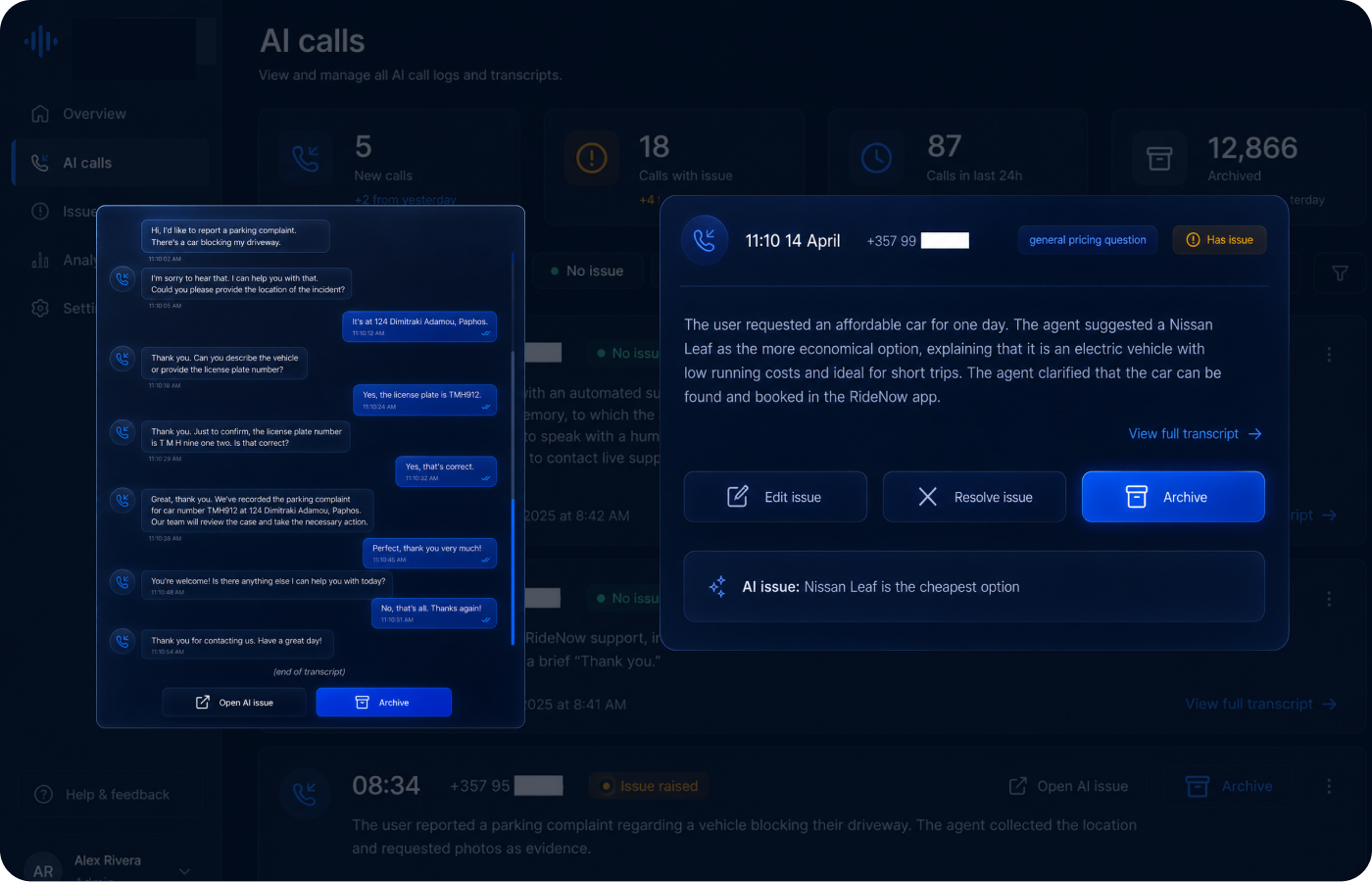
For example, when a resident reports a wrongly parked RideNow vehicle blocking a private parking space, the platform retrieves vehicle and rental information, creates a structured incident report, applies escalation logic, and routes the case to the appropriate operator with conversation summaries and operational context already attached.
Every interaction automatically generates structured records, support tickets, and conversation summaries without requiring manual note taking by operators..
RideNow operates a large car sharing fleet across multiple cities in Cyprus, serving local residents, seasonal visitors, and students. As the business expanded, inbound call volume increased rapidly. The support team handled a continuous flow of calls from users, residents, parking owners, and members of the public interacting with RideNow vehicles and services.
Operators spent a large part of their day answering repetitive operational questions, retrieving information from internal systems, processing routine first line situations, and manually documenting incidents across multiple languages including English, Greek, and Russian.
Seasonal tourism and student activity created additional pressure on the support operation and made scaling multilingual support increasingly difficult.
The company could continue hiring additional staff, but this approach was becoming increasingly difficult and expensive. RideNow needed a more scalable operational model capable of absorbing repetitive inbound calls without continuously expanding support operations.
The platform was integrated with RideNow’s ERP, CRM, fleet management systems, ride management infrastructure, and operational support tooling through a dedicated integration layer.
Before rollout, the Digiteum team analysed real support scenarios, call patterns, and operator workflows to identify repetitive requests suitable for autonomous handling.
The voice agents were trained using RideNow’s operational scenarios, terminology, workflows, and escalation logic used by the support team.
The platform retrieves live operational data, follows predefined workflows, generates structured incident records, escalates cases according to operational rules, and operates directly inside existing business processes.
For example, when a resident reports a wrongly parked RideNow vehicle blocking a private parking space, the platform retrieves vehicle and rental information, creates a structured incident report, applies escalation logic, and routes the case to the appropriate operator with conversation summaries and operational context already attached.
Every interaction automatically generates structured records, support tickets, and conversation summaries without requiring manual note taking by operators..
The rollout started in supervised pilot mode.
Human operators monitored conversations and reviewed automated handling in real time while Digiteum continuously refined escalation logic, optimized workflows, and improved automated handling based on production usage patterns.
The rollout scope expanded gradually as the platform demonstrated stable behavior in production.
The initial pilot focused on a controlled subset of repetitive first line operational requests. Within that rollout scope, the platform autonomously handled approximately 30% of inbound support volume while continuously improving through production usage and operator supervision.
The rollout started in supervised pilot mode.
Human operators monitored conversations and reviewed automated handling in real time while Digiteum continuously refined escalation logic, optimized workflows, and improved automated handling based on production usage patterns.
The rollout scope expanded gradually as the platform demonstrated stable behavior in production.
The initial pilot focused on a controlled subset of repetitive first line operational requests. Within that rollout scope, the platform autonomously handled approximately 30% of inbound support volume while continuously improving through production usage and operator supervision.
Following deployment, RideNow established full 24/7 multilingual voice coverage with zero missed calls and absorbed seasonal support peaks without expanding the support team.
Following deployment, RideNow established full 24/7 multilingual voice coverage with zero missed calls and absorbed seasonal support peaks without expanding the support team.
Following the pilot, RideNow is expanding the platform across all operational cities and increasing its role as the company’s primary first line support layer.
The next phase includes WhatsApp integration and continued expansion of automated operational workflows based on production usage patterns.
Following the pilot, RideNow is expanding the platform across all operational cities and increasing its role as the company’s primary first line support layer.
The next phase includes WhatsApp integration and continued expansion of automated operational workflows based on production usage patterns.
The platform deploys multilingual AI voice agents directly into operational workflows to handle repetitive first line support requests in real time. The agents retrieve and structure operational data during conversations, generate tickets and summaries automatically, follow escalation logic, route situations to the right teams, and interact with connected systems and equipment as part of operational workflows.
Built for operationally intensive environments such as mobility, logistics, parking infrastructure, insurance intake, and field operations, the platform helps companies absorb growing support volume while keeping operations structured, responsive, and scalable.
The platform deploys multilingual AI voice agents directly into operational workflows to handle repetitive first line support requests in real time. The agents retrieve and structure operational data during conversations, generate tickets and summaries automatically, follow escalation logic, route situations to the right teams, and interact with connected systems and equipment as part of operational workflows.
Built for operationally intensive environments such as mobility, logistics, parking infrastructure, insurance intake, and field operations, the platform helps companies absorb growing support volume while keeping operations structured, responsive, and scalable.


